Showing posts with label pop surrealism. Show all posts

Lil Bub: the Art Show


I've long been a fan of famous kitty Lil Bub. I wrote about her over a year ago, and have been following her on social media ever since. But when I learned there would be a Lil Bub appearance and art show at San Francisco gallery Spoke Art, I was conflicted. On one hand, I really wanted to go. On the other, I didn't know if I wanted to admit to myself and others that I would pay over $20 to meet a famous cat. But finally I decided, "Fine. I will be the sort of person who pays over $20 to meet a famous cat." Fortunately, I wasn't the only  one.

Line reached nearly all the way from Jones to Leavenworth.

We're having a heat wave in SF (fyi that means in the 80s), and I am also apparently the sort of person - and in good company - who will stand in the blazing sun for over an hour and a half to meet a famous cat. Massive thanks to the lady who held my spot so I could go get a cold drink, since, winner that I am, I went alone.

I had been doing a lot of soul-searching regarding this famous cat visit (can one feel outrage about the NSA, concern over Syria, and still pay money to visit a famous cat?) and even more soul-searching regarding the art show. It reminded me of Gallery 1988's frequent themed events. I'd loved to have attended their Breaking Bad show (talked about here) if I lived in LA, but it also kinda feels like marketing. And that's a line pop surrealism/low brow has always skirted along. How are these images of pop culture being used? As satire, homage, metaphor, promotion? For fun? And if for fun, is there substance behind it as well? A friend and I wondered this when we attended a Todd Schorr exhibit at the San Jose Museum of Art in 2009. Schorr's work often features recognizable characters from film and cartoons. His large-scale paintings take exacting skill, but while some works used those characters to create deeper meanings, some seemed to be more along the lines of "I like movie monsters so I painted a whole bunch of movie monsters."

I wondered what the range of the art in this show would be. From what I could see of the works from the Breaking Bad show (and other pop culture shows), some artists really explored the themes and ideas in the series, and some just kinda drew Walt and Jesse. I also wondered if I were being too judgmental. After all, what is the substance of a still life?

However, I really enjoyed the Lil Bub art show. There are over 50 works, and they gave me a lot to think about: art, genre, intention. Also, they were, you know, pictures of a cute cat. So, on with the cat art!

Supersonic Space Princess by Arabella Proffer

Now here's a piece where I think, "Style versus substance? Who fucking cares!" I love this piece's Tara McPherson/Lisa Frank sensibility. Here's "space cat" Lil Bub, with a floating crown, in a beautifully colored landscape. There were a lot of "Lil Bub in space" paintings, since part of the "story" is that Lil Bub comes from another planet, but this was my favorite.


Companions of Whimsy, Nicomi Nix Turner

Sorry for the crappy pic, by the way. There were also a lot of "Lil Bub's head surrounded by flowers" pieces, but I liked what Nix Turner did here. Bub's graphite face and bow are pure kitsch, but instead of daisies and butterflies we get mushrooms and less "appealing" insects. I like this exploration of oddness and cuteness and how the two can oppose each other or intersect.


Frail Caress, kikyz1313

I feel like this piece made similar explorations. Lil Bub, while adorable, is a medical oddity. She was a "special needs" kitten and, while currently healthy, continues to need special care. With its depiction of fragility, beauty, decay, and kindness, this piece reminded me of Mary Oliver's poem "The Kitten."


Bub Paints a Space Beetle, Lilly Piri

Although real-life Bub has been known to ruthlessly attack bugs, another artist, Lilly Piri, depicts "different" kitty Bub and insects as kindred spirits. It's suiting - after all, Bub the champion of the strange is different than Bub the actual cat, who just wants pets and yogurt and would maybe like to eat a bug. I liked this charming contribution in Piri's delicate style.


By the Power of Bub by Aaron Jasinski

I had deemed this a "pop surrealism masterpiece" in my mind before I even saw it was by the great Aaron Jasinski. An internet-famous cat. 80s cartoon nostalgia. Celebrities. Pop-tarts. If this isn't a slide in an art history class someday, I will be disappointed.


Lil Bub's Moonlight Ride, Isabel Samaras

Isabel Samaras was another big name in the show. Her work is generally "pop culture figure in unexpected setting," and that's what we get here with Bub replacing E.T. I would not have had so many nightmares about that movie as a kid if the alien had been Bub instead!


Cult of Bub, Heiko Windisch

This was one of the few pieces that looked critically at Lil Bub's fame, though none too harshly. With a quirky storybook style, Windisch shows both the silliness and joy in being a Bub fan.


Lil Bub in Love, Christine Hostetler 

There were two more watercolors by Hostetler of two of Bub's celebrity encounters, but this one, a portrait of Lil Bub and her "dude" (aka owner Mike), was one of my favorites of the show. It's a sweet reminder that at the heart of the Bub frenzy is just a guy and his beloved cat who loves him back. It's easy to forget that despite the fame, this story started off with a man who took in a stray, medically fragile kitten. His love and respect for Bub was shown in how this event was structured (more on that at the end of this post).


Purring, Rebecca Rose

This fun silver ring of Bub popping out of a computer was one of the few non-paintings in the show (others included some yarnwork and a series of photos of a naked woman in a Bub mask). I'm not sure how comfortable it would be to wear, but it would be great for self-defense!


Three pieces by Johanna O'Donnell

Here's another one of those "style versus substance"questions where I'm on the side of style. The project was to make art of Lil Bub, and O'Donnell did that in a gorgeous, entertaining way. Why not have a beautiful triangular painting of Lil Bub and geometric shapes in your living room instead of a painting of flowers? Why the hell not?

These are just a few of the many, many pieces at the show that stood out to me in some way. I'm sure others will have different favorites. There's a play on Schrodinger's Cat, Bub as a comic book character - even a "Heisenbub" for us Breaking Bad fans. I'm glad I decided to wave my crazy cat lady flag and get a ticket.

Update 9/11: Spoke Art posted all of the works here!


More about the event:

The event was limited to 300 people, which was probably too many, simply because of time constraints. While the wait was long and I'm not sure everyone got in, the slowness was for a good reason: Lil Bub's comfort and safety. Bub and her dude were stationed in a smaller gallery. They only let a few people in at a time so that it wouldn't get too crowded and overwhelming for Bub, and you were limited to one gentle pet. Bub was sitting on a blankie, and her dude was within arm's reach signing the books that were included with ticket purchase. She was very calm, but not lethargic - when an assistant waved a feather wand so she'd look at the camera for the family in front of me, she snapped to attention! I don't remember what compliments I babbled to the dude, but I told Bub she was a very good girl.


Bub poses for photos while her dude signs books.


Dry Decadence: Breaking Bad and Art

Frida Kahlo, Without Hope, 1945

I started watching Breaking Bad recently. I don't watch many TV series. Sopranos, Mad Men, Game of Thrones...I know of them and what generally has happened through word of mouth (that Red Wedding was brutal, right?), but have never actually watched them. Breaking Bad was one of those for me. But then I saw the "I am the one who knocks!" monologue on YouTube. Now it's taking all my self control to not completely drive my friends and family insane with talking about my new obsession, which is pretty much why I started this blog in the first place.

I love just about everything about the series, but one aspect I really appreciate is the visual. Its frames are art, and the show and art have intersected quite a bit. Art - from stock hospital wall watercolors to Walt Whitman's "When I Heard the Learn'd Astronomer" - has been important in the series. (Update 8/7: Kara Bolonik's "Leaves of Glass" further explores the Walter White/Walt Whitman connection, and a recent Breaking Bad teaser is Bryan Cranston reading Percy Bysshe Shelley's "Ozymandias."Gallery 1988 did a Breaking Bad themed show, more of the work from which can be seen here. And FaceoftheEarth on Etsy made the news with her Breaking Bad terrarium.


I will show you fear in a handful of dust.


While watching the show's breathtaking shots of the New Mexico skyline and its smaller, tenser, human scenes, different art pieces came to mind, and I decided to start putting them together. For example, the above Frida Kahlo painting, with its desert, Dia de los Muertos imagery, physical suffering, and inner sickness, seems to me a perfect fit for Breaking Bad.


Place

I admire how at one with its setting the show is. While many shows' sense of place is tenuous (Monk's supposed San Francisco, with its front yards and ample street parking, could have been any suburb), Breaking Bad could not happen anyplace else - no more than Twin Peaks could have happened in Orange County or Arrested Development could have happened in the Pacific Northwest. Breaking Bad is firmly in Albuquerque, New Mexico, a sweltering city surrounded by endless desert. The ruggedness of the desert that stretches across the state and into northern Mexico is beautiful, but dangerous. Its vastness allows for cooking meth and testing nuclear weapons far from prying eyes.

This landscape famously captivated and inspired longtime New Mexico resident Georgia O'Keeffe - she of the "vagina paintings" Jane showed Jesse at Santa Fe's Georgia O'Keeffe Museum (maybe Jesse would've preferred this one). Her paintings of New Mexican landscapes and animal skulls bring to mind the beauty, heat-induced confusion, and sense of foreboding of the desert.

Georgia O'Keeffe, Ram's Head with White Hollyhock and Little Hills, 1935


The desert also inspired O'Keeffe contemporary Ansel Adams, whose famous photographs capture the dramatic place where people are dwarfed by land and land is dwarfed by sky.

Ansel Adams, Clouds, New Mexico, 1933


But nature, while powerful, is not untouched in New Mexico. The suburbs and desolate fringes of Albuquerque bring to my mind the sparse paintings of Chris Ballantyne. The dull houses, parking lots, and swimming pools in his work feel intrusive, but precarious. It's easy to imagine the land casually swallowing them up.

Chris Ballantyne, Plateau, 2009


Breaking Bad's interior spaces have their drama too. For me, the show's quiet scenes echo those moody tableaux of Edward Hopper. Skyler, often left to her thoughts and loneliness, especially comes to mind. Her working late to avoid Walt reminded me of Hopper's Office at Night.

Edward Hopper, Office at Night, 1940


Drugs

And you can't have Breaking Bad without drugs! Specifically: blue sky, the blue-tinted ultra-pure meth that is Walter and Jesse's specialty. But there are plenty of other drugs to be had - and not just heroin, cigarettes, and alcohol, but money and power.

This scene takes place in the outskirts of Paris in the late 1800s, not Albuquerque in the early 2000s, and the drug of choice is absinthe, not meth or heroin, but there are definite similarities between it and scenes of addiction in Breaking Bad. The two addicts haven't reached the zombie-like state of the denizens of the rancid flophouse from which Walt rescued Jesse, but they're certainly not doing well. Self-exiled to the sparse city borderlands, only the absinthe matters now.

Jean-Francois Raffaelli, The Absinthe Drinkers, 1881


This painting by Camille Rose Garcia from her Ambien Somnambulants series, with its horror, childishness, and offbeat beauty, reminds me Jane and Jesse's drug-induced downfall. Add a little meth and heroin, and their superhero-creating playfulness turns to petulant beaker-throwing, pissy blackmail attempts, and feverish plans to paint castles in New Zealand. You are not bien, here, Jesse. You are not bien at all.

Camille Rose Garcia, Animals Talk at Midnight, 2008


People

With superb writing and superb acting, Breaking Bad's cast of characters is one of TV's finest. Before watching the show, I knew Bryan Cranston had won a lot of Emmys. After watching the pilot, I was like, "damn, give him all the Emmys." Now that I'm almost caught up, I want to pelt the entire cast with Emmys (and, in fact, Bryan Cranston, Aaron Paul, Jonathan Banks, and Anna Gunn were just nominated today).This is by no means a complete list, as it would otherwise become way too long and nebulous (though I totally want to show Marie this dress), but just whatever art most came to mind with a character. I'd love to know what art has a Breaking Bad character connection for others.

One character might even be getting his own spinoff: lawyer Saul Goodman, whose slime is only matched by his unflappability. The sleazy lawyer character is hardly new (even a cat can do it), but Bob Odenkirk nails it. His Goodman is the Thenardier of this story - incredibly entertaining despite the fact/due to the fact that you'd hate him in real life.  Sure, this painting is of a politician, not a lawyer, but the man's overeager facial expression and calculated lean-in and hand gestures - as well as the two constituents' varying levels of skepticism - remind me of Goodman. If the new show doesn't work out for him, he should consider starting up Goodman, Loblaw & Flynn LLP.

George Caleb Bingham, Country Politician, 1849


The figures in this piece by David Choe might sport boobs, but it feels very Jesse-ish to me. Looking at it, you can imagine the sort of life - sometimes boring, sometimes desperate, sometimes happy - he might have had with pals Badger, Combo, and Skinny Pete had Mr. White never come back into his life.

David Choe, 99 Cent Store


And while we're gender-bending, how about Tuco's vicious, stylish, quietly determined assassin cousins? They'd be worthy opponents for Hellen Jo's trademark badass ladies. (Sorry, bros, but I'm putting my money on Jo's girls. I bet they never even had a "tepidly shoving at your uncle while he drowns your sibling" phase before ascending to ruthlessness.)

Hellen Jo, Shit Twins, 2013


It's hard not to see Walter Jr. in this painting by Manet. He's often at the breakfast table, caught between his two parents: an earnest but strained mother and a manipulative father. Here, the mother looks at the son with concern. The somewhat shady-looking father looks away. The son turns from both of them for the moment.

Edouard Manet, Luncheon in the Studio, 1868


Of course, the driving force of Breaking Bad is its protagonist, Walter White. Greed, fueled by long-standing jealousies and the frustration of powerlessness, has twisted him. This odd painting by James Whistler depicts a wealthy client who stiffed him, and it reminds me of the growing ugliness in Walt - all the sadder when you remember the video he made for his family in the pilot episode.

James Whistler, The Gold Scab: Eruption in Frilthy Lucre, 1879

But while that revenge painting highlights the pathetic side of greed, it can be terrifying as well. Bit by bit, we've seen Walt's transformation from a man who would sacrifice anything for his family to a man who might sacrifice his family. His obsession with his vicious, powerful Heisenberg persona has taken him a long way away from Mr. White, caring father and teacher. He's going down, but will he take his family with him? Will he even care if he does?

Eugene Delacroix, The Death of Sardanapalus, 1827


Sandwich

There are a lot of sandwiches in Breaking Bad, and they're quietly emotional affairs. Walt thoughtfully cuts the crusts of a sandwich he has made for Krazy-8, the drug dealer he has imprisoned in the basement and whom he must kill. Walt seethes while making himself a sandwich in his apartment's kitchen during his and Skylar's separation. Later, Walt cheerfully makes a sandwich and puts it in a brown paper bag labeled "Walt" to take with him to work at his shiny new meth lab. When Walt returns (forcefully) to his family, he treats Walter Jr. to a delicious-looking grilled cheese sandwich. We see Jesse, too, make a sandwich for the neglected toddler who has interrupted Jesse's attempted intimidation of the boy's drug-stealing parents. Making a sandwich in the Breaking Bad universe can be a symbol of survival or a sign - even if faint - of the continued existence of parental love in a vicious world.

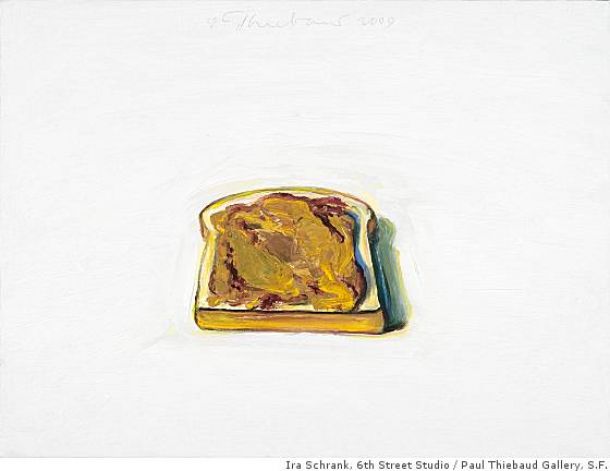
This Thiebaud painting seems like the perfect way to end this post. A humble peanut butter sandwich on American white bread. Unfinished, or perhaps just open-faced, against a stark white background.

Wayne Thiebaud, Peanut Butter Sandwich, 2009


Images:
Kahlo: WikiPaintings
Terrarium: Etsy
O'Keeffe: Wikipedia, Brooklyn Museum
Adams: SFMOMA
Ballantyne: ArtSlant, Hosfelt Gallery
Hopper: iBiblio, Walker Art Center
Raffaelli: Legion of Honor
Garcia: Camille Rose Garcia, Adam Levine Gallery
Bingham: WikiMedia Commons, de Young
Choe: David Choe
Jo: HELLLLLEN
Manet: WikiPaintings, Neue Pinakothek
Whistler: de Young
Delacroix: Wikipedia, Louvre
Thiebaud: SFGate, Paul Thiebaud Gallery

Down the Rabbit Hole: Camille Rose Garcia at the Walt Disney Family Museum

Entrance to the exhibit.


The Walt Disney Family Museum is not a place I'd expect to see a show from artist Camille Rose Garcia. Succubus Spring, from her 2008 show "Ambien Somnambulants," isn't exactly Bambi. But "Down the Rabbit Hole," featuring her illustrations from a recent edition of Lewis Carroll's Alice's Adventures in Wonderland, is on display there until November 3.

Garcia has long had a connection to Disney, but not the kind that the corporation usually embraces. She grew up in suburban Los Angeles, the birthplace of pop surrealism, and Disneyland ("the happiest place on Earth" and "the Magic Kingdom") has often been present in her work, but not necessarily in a flattering way. Her first major show, in 2000 at the Merry Karnowsky Gallery, was bitingly called "The Happiest Place on Earth." A book of her work was called The Saddest Place on Earth. Her mid-career retrospective at the San Jose Museum of Art was called "The Tragic Kingdom." That show's literature stated of her adolescent relationship with nearby Disneyland: "The artist quickly grew to recognize its artifice and contradictions, and she witnessed the realities of privileged suburban life - adolescent alienation and social marginalization. Her precious glittered compositions are infused with a sense of discontent, yielding works that are simultaneously disturbing and attractive."

Also, my sister and I got a good giggle at one of her art books, which includes a piece with the words "fuck face," being in the gift shop of the Walt Disney Family Museum.


Entrance to the museum, in San Francisco's Presidio.


Perhaps the show indicates the museum's goal of being a cultural institution, not just a theme park PR extension. Indeed the museum itself, while certainly heavy on the feel-good marketing, does take a technical look at the evolution of animation and even covers early Disney labor disputes. Still, Camille Rose Garcia at Disney seems like a surprising decision for both parties.

However, Garcia is not the first lowbrow/pop-surrealist to become associated with Disney. Shag, with his hip, mid-century modern SoCal imagery, has become one of Disneyland's official artists, creating posters and merchandise artwork for the park. And while the style of his art is a perfect fit for retro pleasures like the Tiki Room and Tomorrowland, it does make you wonder what his intentions were and are. Art that seemed to be making a comment on cheery consumerism became part of that cheery consumerism. (Full disclosure: I try to be smug about Disneyland but will still eat the churros and ride Pirates of the Caribbean a billion times.)


Garcia, For the Duchess, at the Walt Disney Family Museum.


But to move on to the art at hand: Garcia's illustrations for a new edition of Lewis Carroll's most famous work. I wrote briefly about this project last year for Easter, and weirdly, that post became my blog's most-read, mainly from people searching for "Camille Rose Garcia" in conjunction with "Alice in Wonderland." There's a lot of interest in this, and it's easy to see why. Although John Tenniel's engravings for the original Alice's Adventures in Wonderland are generally considered sacrosanct, if you're going to have another artist update this volume, Garcia is an ideal choice. 


Garcia has said this illustration, The Lobster Quadrille, is her favorite, as it's not a
scene Tenniel had done. Note narwhal with tiny top hat.


Garcia's surrealist bent is a good match for the material. Her work is dreamlike, cartoonish, playful, and dark. She captures the weirdness and loveliness of Carroll's odd scenes. As wondrous and even cute as they can be, there's always an unpredictable danger lurking. Her Alice's goth-girl toughness reminds us that Carroll's Alice was a pretty hard chick - no-nonsense and capable. Garcia's punkish mixture of pinks, purples, and black drive home the fact that Alice is no damsel in distress.


Part of Garcia's Down the Rabbit Hole show.


The work is beautiful: graceful curves, elegant drips, layers of color in acrylic and watercolor, an occasional dash of black glitter. It's vivid, fun, nightmarish. And the museum stages it well, with dark purple walls and black frames. Supplements include the edition she illustrated, a few other editions, and touchscreen stations with an artist bio and sketches. Large murals of Garcia's rendering of the famous tea party scene decorate the walls of the lobby just outside the exhibit.

The show includes a wall of Mary Blair art. Garcia has named Blair, who "brought modern art" to Disney, as an inspiration. An artist most known for her work on Peter Pan, Alice in Wonderland, and the park's Small World ride, it's interesting to see her and Garcia's different, distinctive color palettes and shapes and how they both tackled the challenge of making what Tenniel had illustrated their own.


Blair's concept art for Alice in Wonderland


Access to the exhibit is included in regular ticket purchase. You can see more of Garcia's illustrations for Alice's Adventures in Wonderland at the Merry Karnowsky Gallery's website.


Garcia, detail.

The Phantom Police Man Proudly Powered by Blogger