Showing posts with label roberto bolano. Show all posts

Manuscripts Don't Burn: Books for This

Ellen Manning's poster for The Master and Margarita


This is by no means what I consider a comprehensive list. I have no doubt there are a multitude of works from a multitude of people and places covering these issues, from tomes written by those who have lived in any of the world's dictatorships to the popular genre of dystopian science fiction novels. But these are the ones I know and suggest.


The Master and Margarita by Mikhail Bulgakov

Perhaps ironically, the book that's buoyed me the most since November is a Russian novel. 1930s Stalinist Moscow is already such a surreal place that demonic visitation is hardly the weirdest aspect. There are mysterious disappearances, labyrinthine but unassailable rules about everything, and overbearing but unspeakable truths, so what's a talking cat or a dance for hell's denizens? Muscovite Margarita has lost her lover, a writer who was whisked away by the authorities due to the subject of his novel. Will a mysterious stranger and his mischievous coterie be able to help her get him back?

Bulgakov wrote The Master and Margarita knowing that it could never be published in his lifetime. He even burned an early draft, wary and despairing, but later soldiered on with his secret writing. The book's very existence is a testament to the survival of art in impossible situations and support for one of its claims: manuscripts don't burn.


By Night in Chile by Roberto Bolaño

By Night in Chile is a feverish novella told in (mostly) one paragraph: the deathbed ramblings of fictional Father Urrutia, a priest and intellectual who was recruited to teach the "enemy tactics" of the left to the top brass of the new (and covertly USA-assisted) Pinochet regime. The defensive, opaque narrator is unsympathetic, but one wonders what he or she would have done differently, and what difference it would have made. While maddening in parts (it includes a Bolaño trademark: a lengthy, esoteric list - in this case a survey of churches using trained falcons to protect historic buildings from pigeon poop), the work reaches a heart-pounding climax when what lies beneath a literati dinner party is revealed.

By Night in Chile is a stark reminder that dictatorships come and go, but for their survivors, actions taken or not taken can last a lifetime in one's conscience.


The Handmaid's Tale by Margaret Atwood

I admit I haven't been able to re-read this one recently; much like George Orwell's 1984, it's too close to home now. However, I plan to steel myself and dive in, since it has an eerily well timed miniseries coming in the spring. The Handmaid's Tale, a novel of women's oppression under a far-right group that has seized power in America, is an important reminder of how quickly the unthinkable can turn into something you're being told to get used to.


The Rougon-Macquart series by Émile Zola

During this election season, I've been thinking of the French disaster (or La Debacle, as Zola put it) that was the Franco-Prussian War, where seemingly every bad decision that could be made was made. Zola's series of novels covering the years leading up to this war and the fall of the Second Empire - a time Zola lived through - has some intriguing parallels to today's society, especially the extreme social stratification. As a conduit of mid-to-late-19th Century French history, with its many protests and rebellions, the novels are also a reminder that progress is a struggle, and it's not always clear where or when a decisive victory will arrive.

In L'assommoir, blacksmith Goujet decides not to join in the protests of Napoleon III's 1851 coup d'etat, feeling burned out and discouraged by the protests of 1848. However, he does hesitate and wonders if, "one day the people might regret having stood by with folded arms." 


Suite Française by Irène Némirovksy

Successful writer Irène Némirovksy was living in France with her husband and children when Germany invaded. She immediately began work on a planned series of novels which were to chronicle the invasion, the resistance, and then whatever the outcome of the war would be. After finishing drafts of the first two novellas, however, Némirovksy, who was Jewish by birth (she and her husband were converts to Catholicism), was arrested and sent to Auschwitz, where she died. Her husband's arrest and death at Auschwitz soon followed, but the nanny managed to get the children to safety. Némirovksy's eldest daughter, Denise Epstein, found the drafts and an outline for a third book many decades later, when she was going through her mother's papers before donating them.

The surviving writings were published as Suite Française, a captivating and near-contemporaneous account of the chaos of the initial siege of Paris and then the strange new reality of life under German rule. Knowing Némirovksy's fate, the glimmers of hope are all the more bittersweet. 


Courbet's Le Pont Ambroix

And to finish, here is the poem "Good Bones" by Maggie Smith. "Good Bones," both comforting and clear-eyed, went viral in the wake of the Orlando massacre - a rare feat for a poem. A broadside is available here.


Images:
"Manuscripts Don't Burn" poster by Ellen Manning: Master & Margarita website
Le Point Ambroix: wikimedia
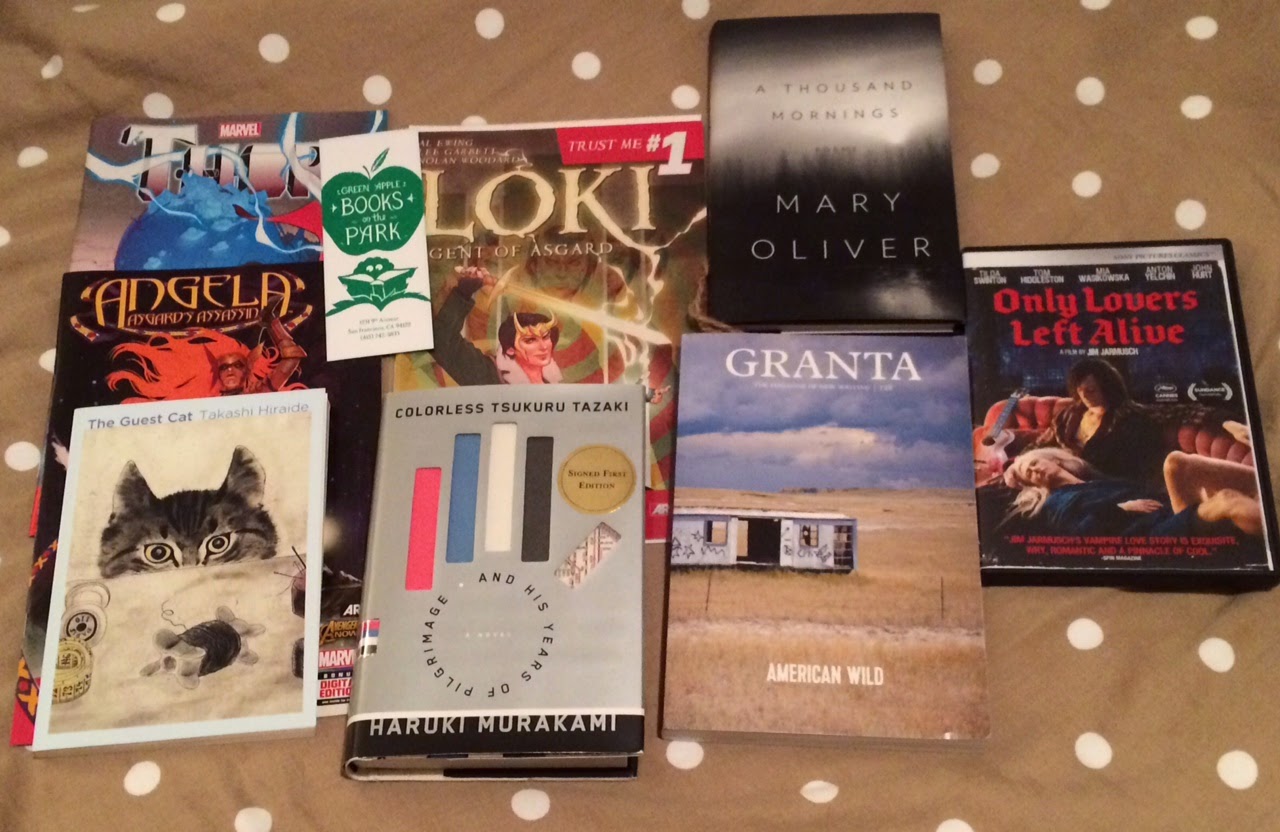
My Favs of 2014

I also really like the polka dot duvet cover I got on sale.


This is by no means a definitive "best of 2014" list. I have not read, watched, or looked at enough things to make such a list. Just a few of my favorite things I read, watched, and looked at in 2014.


Books


Colorless Tsukuru Tazaki and His Years of Pilgrimage by Haruki Murakami - My absolute top favorite piece of media in any medium this year. After the unwieldy 1Q84, some worried Murakami had lost his touch. But this year we got a translation of his latest novel, which is also one of his best. A shy young man's life is upended when his close-knit group of friends mysteriously abandon him. Many lonely years later, he finds the courage to confront them about what happened. The novel also handles a tough topic (that coincidentally became an explosive topic in 2014) with compassion and intelligence.

The Guest Cat by Takashi Hiraide - Man doesn't consider himself a "cat person." Then he meets a cat. I also read Tom Cox's Under the Paw, a book about a man who considers himself a cat person and obtains lots of cats. (Ironically, the above Murakami was uncharacteristically catless.)

A Thousand Mornings by Mary Oliver - This collection is likely the swan song of this great poet. A Thousand Mornings is no American Primitive, and I admit I thought her poems about her late dog Percy were overwrought (until my own elderly cat passed away). But it did include one of my new favorite lines ever, in "Out of the Stump Rot, Something": "If you like a prettiness,/ don't come here./ Look at pictures instead,/ or wait for the daffodils."

Other favorites that are not from 2014 but that I read for the first time in 2014:

The Savage Detectives and Amulet by Roberto Bolaño - I went on a Roberto Bolaño binge this year. Like Balzac, Bolaño works with a large cast of characters who span the globe but are mostly rooted in Mexico City. Of these, my favorite is Auxilio Lacouture, a middle-aged drifter and literary devotee from Uruguay who calls herself the "mother of Mexican poetry." In one chapter of Savage Detectives, she tells her story of staying in a bathroom during the army's 1968 takeover of the University of Mexico. In the novella Amulet, we get a fuller picture of her hardscrabble, poetry-filled life.

Gone Girl by Gillian Flynn - I don't usually read thrillers, but when I saw the incredible trailer, I knew I needed to read the book ASAP or I would look up spoilers. Even if you know some of the twists, it's still a tense "in one sitting" read. (Warning: there will be some spoilers in my ramblings on the movie version below.)


Short Stories


"Someone in the Room Will" by Falcon Miller in The Rag - Even when I'm fortunate enough to get a contributor's copy of a literary magazine, I'm still convinced my piece was the worst piece. My favorite piece, however, in my contributor's copy of The Rag #6, was Falcon Miller's clear-eyed but empathetic portrait of a woman who is just not going to make it in society.

"River So Close" by Melinda Moustakis in Granta - Another story told about people at the fringes, "River so Close" in Granta #128 tells the story of a younger, sharper woman who is a seasonal worker at an Alaskan cannery where danger takes many forms.


Art


For the Sake of Being(s), Katy Horan and Katherine Rutter at Gallery LeQuiVive in Oakland - I'm a longtime fan of Horan, but this joint show focusing on nature and dark femininity was my first introduction to Rutter's work.

Modern Nature: Georgia O'Keeffe and Lake George, O'Keeffe retrospective at the de Young in San Francisco - The giant flowers were there, but this exhibit showed off the artist's range of subjects, from abstract, modern cityscapes to landscapes far removed from her well known desert scenes.


Movies 

It was a great year for Marvel actors doing arty genre pieces.


Snowpiercer - A cruelly topical, claustrophobic, existential nightmare in which director Joon-ho Bong somehow seamlessly includes slapstick humor and kick-ass action. After the human-caused apocalypse, Earth's only survivors live on a socially stratified train doomed to circle the globe continuously (Marvel Person Count: 1, Captain America. Tilda Swinton: Yes. John Hurt: Yes.)

Under the Skin - This "alien has moral crisis on Earth" movie directed by Jonathan Glazer is...not for everyone. I had to reflect on it for a while before I even knew if it was for me. It's a contemplative film with beautiful visuals and little dialogue. Several people in the viewing I attended walked out, most memorably some guy who apparently decided he just could not watch Scarlett Johansson slowly, slowly, slowly, ever so slowly eat cake. That was where this unknown man drew the line. (Marvel Person Count: 1, Black Widow. Tilda Swinton: No. John Hurt: No.)

Only Lovers Left Alive - The main characters are vampires in this Jim Jarmusch film, but this is less of a "vampire movie" than it is a funny, moving family drama that takes place in deserted Detroit, USA and vibrant Tangier, Morocco. A sunny, earthy woman and her younger musician husband deal with his depression and her reckless little sister. (Marvel Person Count: 1, Loki. Tilda Swinton: Yes. John Hurt: Yes.)

Gone Girl - I read the book so I wouldn't look up spoilers for the movie, and then I had to wait for what felt like forever for the movie! I enjoyed this David Fincher adaptation - I'm sure it helped that Flynn did the screenplay. Some see Amy Elliot Dunne as the ultimate "men's rights activist" strawwoman, but I think she's her own great villain, and Rosamund Pike was excellent in this role (favorite moments: competitive miniature golf, post-murder hair-flip, and that grin at Ben Affleck from the examination room). Although true to the source material, the movie managed to add to a lot of dark humor. Missi Pyle as fake Nancy Grace was a great bonus. (Marvel Person Count: -0.5, with 0.5 for Daredevil and -1 for Batman. Tilda Swinton: No. John Hurt: No.)

Captain America: The Winter Soldier & Guardians of the Galaxy - with a topical political thriller and zany-cute space comedy, Marvel proved it can keep their millions of superhero movies fresh. (Marvel Person Count: check with payroll. Tilda Swinton: No. John Hurt: No.)


TV


Gotham - This prequel series is cheesy and trying to cram in too many famous characters, but I love it. Robin Lord Taylor is an absolute breakout as Oswald Cobblepot (better known as the Penguin) steadily working his way up the ranks of the Gotham underworld. Jada Pinkett Smith, as new character Fish Mooney, is over-the-top and entertaining as a villain who mixes deadliness with the camp of the 1960s series.

South Park - Who knew 18 was a lucky season? The show, which began as a crudely animated short in 1992, found new life in 2014 by drawing inspiration from Silicon Valley, gluten, and pop-star/middle-aged geologist Lorde.


Comics

And...the Rainbow Brite theme song's in my head.


Loki: Agent of Asgard - The Asgardians had quite a 2014, which should provide the foundation for a great 2015. Except for Thor, who lost the power to wield Mjolnir and was replaced by a new Thor (popular new name for old Thor as suggested by Katie Schenkel: Snortblat). Loki: AOA started in February, and then led to a mini-series, Thor & Loki: the Tenth Realm, where the brothers met their long-lost older sister, Angela, who then got her own book, Angela: Asgard's Assassin. And a new Thor has begun telling the story of the still-unknown woman who has taken Snortblat Thor Odinson's place as Thunder God.

Loki: AOA has been my favorite, though. Continuing the extreme identity crisis and self-hatred that Kieron Gillen launched for him at the end of Journey Into Mystery, AOA finds Loki living in New York, singing in the shower, playing video games, grilling salmon, and making yet another take-no-shit platonic female friend. But of course, drama finds him. With clever writing by Al Ewing and art by Lee Garbett, highlights have included a guest appearance by Doctor Doom and goddaughter Valeria, the most determined band of juggling-themed supervillains ever, and an obnoxiously heroic Loki who can turn into Thor AND a unicorn.


Tusk: It Is What It Is


In the Roberto Bolaño short story "The Colonel's Son,"* the narrator describes to the reader a late-night, low-budget zombie movie he has just seen. The movie in question is "a bad film, or the sort we call bad," but he still finds it "revolutionary." He can't really explain why. He says that the film was, "pathetic really, full of cliches and tired devices, prejudices and stereotypes, and yet at the same time, every frame was infused with and gave off a revolutionary atmosphere, or rather an atmosphere in which you could sense the revolution, not in its totality, but a fragment...as if you were watching Jurassic Park, except the dinosaurs never showed, no, I mean as if it was Jurassic Park and no one even mentioned the fucking reptiles, but their presence was inescapable and unbearably oppressive."

I don't think Tusk is revolutionary or infused with revolution. And there are other odd genre films I've watched in the past twelve months that I've liked more but haven't written about (Only Lovers Left Alive, Under the Skin, Snowpiercer). If I hadn't been reminded so strongly of Bolaño's story while watching it, I probably wouldn't have written about Tusk, either. But like Bolaño's narrator, I kept sensing...something. The best I can articulate it is to say it is what it is. Is it a great film? No. But despite the fact that it was basically a dare that came from a joke and is purposely trying to be a movie like "The Colonel's Son" but without the lack of a budget, it is still sincere. It's hard to say what I would change about it. Another artsy horror movie I recently watched, We Are What We Are, by contrast, is so gorgeously shot and acted that the flaws drive you (or at least me) crazy. "You almost had it!" I wanted to scream at We Are What We Are's stupid-ass ending. Tusk also had an ending that makes zero sense, and yet it fits. It all fits together, even the parts that don't fit, into one curio that could rest on a mantel in the villain's creepy, intriguing mansion. 

Among the other parts that don't fit but do fit are a Quebecois caricature of a detective (played by Johnny Depp, whom I did not recognize), lengthy character monologues (a Kevin Smith standard), and a romance between gorgeous Genesis Rodriguez's Ally and pale, schlubby Haley Joel Osment's Teddy (another Kevin Smith standard, although to be fair, this is a picture of him and his wife of fifteen years). But even though I don't entirely disagree with the review Johnny Depp Ruins Kevin Smith's Tusk, I don't feel compelled to edit that character out of the film. It's a misstep, but it's a weird misstep in a weird film. Rodriguez is moving in her to-the-camera mid-film confession. And the affair between her and Osment's characters manages to feel sweet. 


Justin Long and Michael Parks in Tusk

The main character, Wallace, is played by Justin Long. Long is most known for a series of Apple commercials in which his obnoxiousness and John Hodgman's affability somehow made behemoth corporation Microsoft a lovable underdog. Basically, Long was a good choice for this role where someone gets turned into a walrus but you don't feel that bad about it.

Wallace is an insecure prick of a comedian, and very much of the zeitgeist: his podcast consists of Tosh.0-style mocking of people's internet video fuck-ups, and his "ironic" racism includes Nazi jokes and inaccurate imitations of his Hispanic girlfriend's supposed accent. He's just charming enough - or rather, they can remember when he was just charming enough - that Ally and Teddy can't quite bring themselves to say, "That's racist. STFU." But I - and many (most?) of the audience - am complicit in some of this. If you've never laughed at someone's stupidity-fueled misery on Youtube (Go! Bwah!), you're a better person than I. With the internet, viciousness is easy.

But while Wallace's material is current, there's nothing new about his white male hubris. During their initial meeting, Wallace and Howard Howe (Michael Parks, also in We Are What We Are, giving a brave, delightful performance here) reverently discuss Ernest Hemingway and Rudyard Kipling, and it's clear Wallace sees himself fulfilling this role of "young male adventurer" without care for whomever gets trampled in the process. Later, Howard brings Coleridge's The Rime of the Ancient Mariner** into the conversation, but Wallace doesn't catch the subtle warning there.

It's too late, anyways, because he's been drugged and will soon be subjected to a series of Regretsy-level surgeries that will turn him into a walrus...sort of. Meanwhile, even though they've been sleeping together behind Wallace's back, earnest-at-heart art-lovers Ally and Teddy set off to rescue him. And there's a battle scene it would be a crime to not release behind-the-scenes footage of that made me feel bad for snarking on Justin Long. He's a trooper.

And that's Tusk. Somewhere in between The Human Centipede's pure-shock surgery-horror and Boxing Helena's*** wannabe-artsy surgery-horror, with a million Canadian jokes thrown in. With something corny but affecting to say about tears. Maybe the tender way Teddy puts his arm around Ally as they leave a ludicrous but sad situation reminded me of the end of "The Colonel's Son" when a strict, bottled-up military father calls out in vain for his son who has decided to die with his zombie girlfriend.

It is what it is.

Medically accurate diagram from Smith's Instagram.

*"The Colonel's Son" was published in issue 117 of Granta. It's not available online, but there's a visual representation of part of the movie-within-the-story here. The story is included in Bolaño's collection The Secret of Evil.

**I recently reread "The Rime of the Ancient Mariner," and man, the mariner was a dick. After the albatross meets the sailors, it "every day, for food or play,/ Came to the mariner's hollo!" This sweet little (well, not little) albatross is having a good time playing with the crew and getting snacks, they probably named it Mr. Flap-Flap or something, and then this dick-face shoots it for no reason. Yeah, you ride on your zombie boat and think about what you've done, douchebow. 

***Don't want to watch Boxing Helena? You don't have to, thanks to Jason MacIssac's in-depth review in its vintage 90s habitat.


The Phantom Police Man Proudly Powered by Blogger